Handwriting expert and signature verification
When a will, cheque, agreement or letter may be forged, a handwriting expert settles it. We have the handwriting or signature compared with genuine samples by a handwriting examiner, and give you their written opinion. It helps you decide whether to challenge the document, and your lawyer decide how.
When people come to us
- A will or property paper carries a signature you believe is not genuine.
- A cheque was signed by someone other than the account holder.
- An agreement or a letter is disputed.
- An anonymous letter needs to be traced to its writer.
How we do itFour steps, inside the law.
- 1
The documents
The disputed paper, and genuine samples of the person's writing.
- 2
The comparison
Letter shapes, pressure, spacing and flow, side by side.
- 3
The opinion
A written opinion, with its reasons.
- 4
Next steps
What the opinion means for your case, with your lawyer.
What we do not doAn opinion is only as good as the samples. We tell you plainly when there is not enough to compare.
What you getFacts, only for you.
- A written opinion with reasons
- Side-by-side comparisons
- Advice on which genuine samples are needed
What the law says about a handwriting expert's opinion
Since 1 July 2024 the Bharatiya Sakshya Adhiniyam, 2023 has replaced the Indian Evidence Act. Section 39 makes the opinion of a person skilled in identifying handwriting relevant in court; it was section 45 of the old Act. Section 41 lets the court also hear someone who knows the person's writing because they have seen them write, have received documents written by them in answer to their own, or regularly received their papers in the course of business (old section 47). Section 72 lets the judge compare the writing personally, and even ask a person in court to write words or figures for the comparison (old section 73).
Digital signatures have their own rules. Section 39(2) covers the Examiner of Electronic Evidence notified under the IT Act, and sections 85 to 87 set what a court presumes about electronic agreements, secure electronic signatures and signature certificates.
How much weight a court gives the opinion
In Murari Lal v. State of Madhya Pradesh (1979) the Supreme Court held there is no rule of law that an expert's opinion must be corroborated before a court acts on it. It also said the science is imperfect, so a court must test the expert's reasons and weigh the rest of the evidence. In Padum Kumar v. State of Uttar Pradesh (2020), a criminal appeal, it said a court should see that the opinion is supported by other evidence, direct or circumstantial, before acting on it.
So an opinion counts for most beside other facts: who held the document and since when, the dates, the bank's record of a cheque, a person who saw the signing. Plan to put it before the court with those facts, not on its own.
The samples decide the answer
An examiner compares the disputed writing with writing known to be genuine. The standard most document examiners follow prefers originals of both. With only a photocopy, the examiner first judges whether the fine detail is clear enough, goes only as far as it allows, and reports where it falls short.
Genuine samples are of two kinds. Writing made in ordinary life before any dispute, such as cheques, signed letters, registers and forms, shows a person's natural habits. Writing made on request can repeat the disputed words exactly, but people often write stiffly when asked. A good set has both.
- Samples of the same kind: signatures against a signature, Marathi against Marathi, capitals against capitals.
- Samples from around the same time: within two or three years of the disputed writing, or some from before it and some from after.
- Several samples, never one: a genuine signature changes a little every time, and the examiner needs to see that range.
- Originals wherever you can get them, and the disputed paper kept flat, with no staples, folds, punch holes or pen marks near the writing.
What a forged signature tends to show
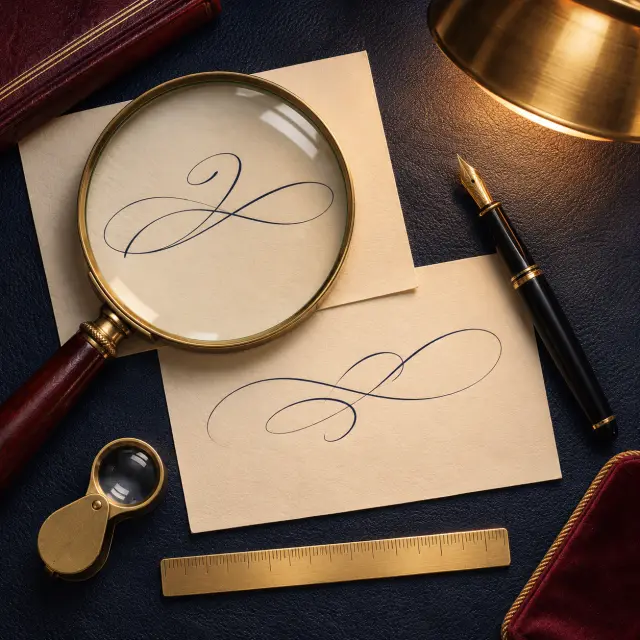
Forged signatures are made in three main ways. Some forgers write the name in their own hand without trying to copy it. Others copy a genuine signature freehand, drawing it slowly, which can leave shaky strokes, pen lifts in odd places and blunt starts and stops. The third way is tracing over a genuine signature, against light, with carbon, or by pressing lines into the paper first. Two signatures that match each other exactly are a warning in themselves, because nobody signs the same way twice.
Government examiners and private examiners
Maharashtra's State CID runs a Handwriting and Photographic Bureau under the Chief State Examiner of Documents. Its first bureau opened in Pune in 1939, and it now has units in Pune, Mumbai, Nagpur and Aurangabad. It examines questioned signatures, alterations, anonymous letters and forgeries for the police, the courts and government departments.
A private opinion is for the stage before that: you hold a will, a cheque or an agreement you doubt, and you have to decide whether to challenge it, file a complaint or settle. Once a case is in court, the judge decides which opinions to hear and can compare the writing personally under section 72.
Before you act on a doubtful document
- Keep the original safe and unmarked, and give copies to everyone else.
- Gather genuine writing of the same person from around the same date before you raise the doubt with anyone; once a dispute starts, people stop handing over old papers.
- Write down who held the document, from when, and how it reached you.
- Take the opinion to your lawyer before you file anything.
Sources
- Bharatiya Sakshya Adhiniyam, 2023: sections 39, 41, 72 and 85-87
- Notification S.O. 849(E): the BSA in force from 1 July 2024
- Old and new sections side by side (Uttar Pradesh Police)
- Murari Lal v. State of M.P., (1980) 1 SCC 704
- Padum Kumar v. State of U.P., Criminal Appeal 87 of 2020
- Maharashtra State CID: Handwriting and Photographic Bureau
- SWGDOC Standard for Examination of Handwritten Items
- ASQDE: known handwriting specimens
- Norwitch Document Laboratory: signatures and forgery
Questions people askAbout handwriting expert.
What samples do you need?
The disputed document, ideally the original, and several genuine signatures or writings of the same person from around the same time.
Can the opinion be used in court?
Indian courts can consider the opinion of a handwriting expert (Bharatiya Sakshya Adhiniyam, 2023, section 39; section 45 of the old Evidence Act). The court decides what weight it carries.
Can you work from a photocopy?
Sometimes, but an original gives a far surer answer.
Is it confidential?
Yes.